


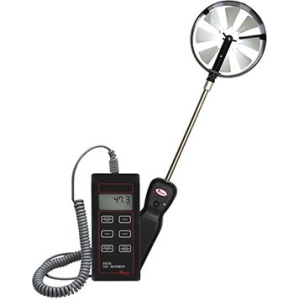


Anemometers & Air Flow Meters
Anemometers and air flow meters measure air velocity, volume flow, and related environmental parameters, used in HVAC balancing, industrial ventilation, and environmental monitoring. We stock vane, hot-wire, and rotating vane anemometers for field and process air flow measurement.
Types of Anemometers
Vane (rotating vane) anemometers use a small propeller-style sensor to measure air velocity, offering a durable and cost-effective option for duct and open-area airflow measurement. Hot-wire anemometers measure air velocity by detecting cooling effects on a heated wire, providing high sensitivity for low air velocities and tighter spaces such as diffusers and grilles. Some models combine air velocity measurement with temperature and humidity sensing for comprehensive HVAC diagnostics in a single instrument.
Measurement Range & Units
Air velocity ranges in this category typically span from near-zero low-flow conditions up to 30+ m/s (roughly 6,000+ fpm) on higher-range models, with most units able to display readings in multiple units (m/s, fpm, km/h, mph) and calculate volumetric flow (CFM/CMH) when paired with duct or opening dimensions.
Choosing the Right Anemometer
Vane anemometers are well suited for general duct and open-air measurement where moderate to higher velocities are expected. Hot-wire anemometers are preferred for low-velocity applications, tight diffuser openings, or situations where the probe needs to fit into small access points.
Common Applications
- HVAC air balancing and duct testing
- Industrial ventilation and exhaust system verification
- Cleanroom and laboratory air flow monitoring
- Wind and outdoor air velocity measurement
- Fume hood and safety cabinet face velocity testing
Not sure which anemometer fits your application? Contact our team — we can help match sensor type, range, and features to your specific requirement.
Frequently Asked Questions
Should I choose a vane or hot-wire anemometer?
Vane anemometers work well for general duct and open-area measurement at moderate to higher velocities. Hot-wire anemometers are better suited for low-velocity readings and tight spaces like diffusers, due to their smaller probe and higher sensitivity.
Can anemometers calculate air volume, not just velocity?
Yes, many models calculate volumetric flow (CFM or CMH) by combining the measured velocity with a manually entered duct or opening area, useful for HVAC balancing work.
What’s a typical accuracy for an anemometer?
General-purpose anemometers typically offer accuracy around ±3% to ±5% of reading, with higher-precision models available for calibration and lab reference use.
Do you provide calibration certificates for anemometers?
Yes, select models are available with a NIST-traceable calibration certificate at the time of purchase. Look for the certification filter above or contact us for a custom calibration request.