


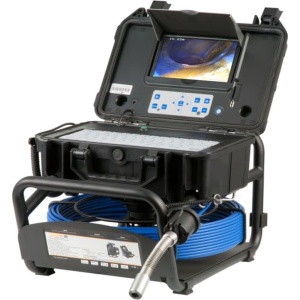

Drain & Sewer Cameras
Drain and sewer cameras let plumbers and inspectors see inside a pipe without digging, cutting, or guessing at what’s causing a blockage. We stock push cameras, self-leveling systems, and pan-and-tilt units built for residential drain lines, commercial sewer mains, and municipal infrastructure inspection. A camera head travels through the pipe on a semi-flexible push rod while the operator watches a live feed, spotting cracks, root intrusion, grease buildup, and offset joints that no amount of manual troubleshooting could confirm.
Self-leveling camera heads automatically keep the image upright as the camera rolls through bends and turns, making them the standard choice for pipes with tight corners. Pan-and-tilt heads rotate and tilt to inspect larger diameter pipe from multiple angles, useful where a fixed forward view misses damage along the pipe wall. Most systems add a built-in sonde, a locating transmitter that lets a second technician trace the camera head’s exact position from above ground once it disappears underground.
Types of Sewer Cameras
Mini push cameras handle 2 to 4 inch pipe on shorter reels, suited to residential drain lines and lateral inspections. Self-leveling push cameras scale up to 3 to 8 inch pipe, sometimes larger with a centering skid, and keep the image upright through tight corners over reel lengths up to several hundred feet. Pan-and-tilt cameras rotate and tilt the lens for a full view of larger diameter pipe, useful for inspecting pipe walls from multiple angles rather than a single forward view. Crawler camera systems drive themselves through large diameter or long-distance municipal pipe where a push rod alone can’t cover the distance.
Common Applications
- Residential drain and lateral line inspection
- Commercial and municipal sewer main inspection
- Pre-purchase home inspection and property assessment
- Pipe condition assessment before trenchless lining or repair
Choosing the Right Camera
Match reel length and camera diameter to your pipe size and run length first, then decide between self-leveling and pan-and-tilt based on how many turns the pipe has and whether you need multi-angle views. Add a sonde-equipped model whenever you need to locate the camera head from above ground.
Not sure which sewer camera fits your job? Contact our team — we can match camera type, reel length, and locator features to your inspection work.
Frequently Asked Questions
What’s the difference between a self-leveling and a pan-and-tilt sewer camera?
A self-leveling camera automatically keeps its image upright as it moves through bends, making it well suited to pipes with sharp turns, while a pan-and-tilt camera rotates and tilts to inspect larger pipe from multiple angles.
What does a sonde do on a sewer camera?
A sonde is a built-in locating transmitter in the camera head that lets a technician trace its exact position underground using a separate locator device from above ground.
What pipe diameter can a push camera handle versus a crawler camera?
Push cameras typically cover 2 to 8 inch pipe depending on the model, while crawler cameras are built for larger diameter or longer-distance municipal pipe that a push rod system can’t reach.
Can a sewer camera detect root intrusion and pipe cracks?
Yes, a clear video feed from inside the pipe reveals root intrusion, cracks, corrosion, offset joints, and blockages, giving a direct view of pipe condition instead of relying on guesswork.