


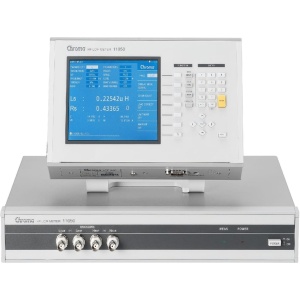


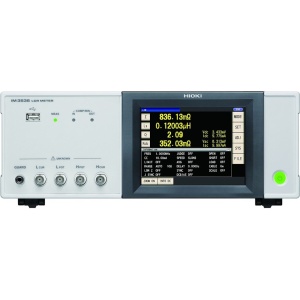


LCR Meters
LCR meters measure inductance (L), capacitance (C), and resistance (R) of electronic components, used to verify component values, identify defective parts, and characterize circuit elements in design and quality control work. We stock handheld and benchtop LCR meters covering a range of test frequencies and accuracy classes.
Handheld vs. Benchtop LCR Meters
Handheld LCR meters offer portability for field service, component sorting, and general troubleshooting, typically testing at a fixed or limited range of frequencies. Benchtop LCR meters provide higher accuracy, adjustable test frequency and signal level, and often data logging capability, making them the standard choice for R&D, incoming inspection, and production quality control.
Test Frequency
Component measurements can vary depending on the test frequency applied, since real-world capacitors and inductors don’t behave as ideal components across all frequencies. Benchtop LCR meters with adjustable test frequency allow characterization of components at the frequency relevant to their actual circuit application, while fixed-frequency handheld meters are sufficient for general component verification.
Accuracy & Test Parameters
In addition to primary L, C, and R values, many LCR meters also measure secondary parameters like dissipation factor (D) and quality factor (Q), which describe how closely a component behaves like an ideal capacitor or inductor — useful for identifying degraded components that may still show a correct primary value.
Common Applications
- Component verification and sorting
- Incoming inspection and quality control
- Circuit design and R&D characterization
- Failure analysis and defective component identification
- Educational and training lab use
Not sure which LCR meter fits your application? Contact our team — we can help match test frequency range, accuracy, and features to your specific requirement.
Frequently Asked Questions
Should I choose a handheld or benchtop LCR meter?
Handheld LCR meters are suited for field service and general component verification. Benchtop LCR meters offer higher accuracy and adjustable test frequency, making them preferred for R&D and quality control applications.
Why does test frequency matter for LCR measurement?
Real-world capacitors and inductors can measure differently depending on the test frequency applied, so testing at a frequency relevant to the component’s actual circuit application provides a more meaningful measurement than a single fixed frequency.
What do dissipation factor and quality factor tell me?
Dissipation factor and quality factor describe how closely a component behaves like an ideal capacitor or inductor, helping identify degraded components that may still show a correct primary L or C value but perform poorly in an actual circuit.
Do you provide calibration certificates for LCR meters?
Yes, select models are available with a NIST-traceable calibration certificate at the time of purchase. Look for the certification filter above or contact us for a custom calibration request.